Showing posts with label Verbs. Show all posts

Thursday, 31 May 2012

Past Perfect Simple

The past perfect simple expresses an action taking place before a certain time in the past.

Form of Past Perfect Simple


Positive
Negative
Question
no differences
I had spoken.
I had not spoken.
Had I spoken?
For irregular verbs, use the past participle form . For regular verbs, just add ed.

Exceptions in Spelling when Adding ed

Exceptions in Spelling when Adding ed
Example
after final e, only add d
love – loved
final consonant after a short, stressed vowel
or l as final consonant after a vowel is doubled
admit – admitted
travel – travelled
final y after a consonant becomes i
hurry – hurried

Use of Past Perfect

  • action taking place before a certain time in the past (putting emphasis only on the fact, not the duration)

Example: Before I came here, I had spoken to Jack.

  • Conditional Sentences Type III (condition that was not given in the past)

Example: If I had seen him, I would have talked to him.

Signal Words

already, just, never, not yet, once, until that day (with reference to the past, not the present)

Monday, 28 May 2012

The Imperative Form

You can use the imperative form to give an order, a warning, or some advice.

To form the imperative, use the infinitive form of the verb without "to". To make a negative imperative, put "do not" or "don't" in front of the verb, as in, "Don't speak!"
Affirmative
Negative
Come here
Don't cross the street
Go there 
Don't say that
Open the door 
Don't be late 
Turn on the TV 
Don't fight 
Sit down 
Don’t go

The imperative is formed the same for all subjects (you, he, we, they), but you can include yourself in the imperative by adding "Let's," as in, "Let's go for a swim".
Affirmative
Negative
Let's work!
Let’s not work!
Let's make a party!
Let's not make a party!
Let's go!
Let's not go!
Let's play!
Let's not play!
Let's go home!
Let's not go home!


Activities:

Saturday, 19 May 2012

Must & Mustn't

Must is a modal auxiliary verb. In one of its meanings, it is used to give strong advice or orders (to oneself or to other people).

Affirmative
I
You
He
She
It
We
You
They
must
go
come
work
live
speak

Mustn't means that it is neccesary that you do not do something.In other words, it is used to tell people not to do things.

Negative
I
You
He
She
It
We
You
They
must not
mustn't
go
come
work
live
speak

We use the questions with must to ask about the intentions of wishes of the person one is speaking to.

Interrogative
Must
I
you
he
she
it
we
you
they
go?
come?
work?
live?
speak?

Affirmative answers
Negative answers

Yes,
I
you
he
she
it
we
you
they
must.
No,
I
you
he
she
it
we
you
they
mustn't.

Friday, 11 May 2012

Can & Can't

Learn how to use can and can't with these funny pumpkins:


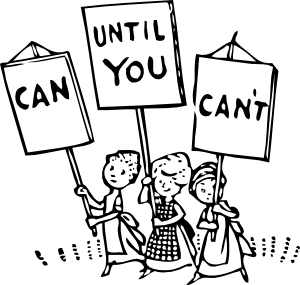
Can Until You Can T Clip Art

Can is an auxiliary verb that we use to:
  • Talk about possibility and ability.
  • Make requests.
  • Ask for or give permission.
The structure of can:
  • subject + can + main verb

The main verb is always the infinitive without "to".

subject
auxiliary verb
main verb

+
I
can
read
a book.
-
He
can't /cannot
read
a book.
?
Can
you
read
a book?

  • Can is invariable. There is only one form of can.
  • The main verb is the infinitive without "to".

Activities:
  • From The Yellow Pencil, a page with listenings, rules and exercises.
  • English Exercises offers you three different activities: 1, 2 & 3.
  • Some exercises from Better English:   1, 2 & 3.

Tuesday, 8 May 2012

Ancient Olympic Games

Here you have two videos to know the history of Ancient Olympic Games while working on the simple past:


Sunday, 6 May 2012

Must & Mustn't: Activities

To practise must and mustn't, take a look at this presentation, and after, do the activities below.


Activities:

Thursday, 29 March 2012

You're so Vain: Irregular Verbs

A perfect opportunity to review some irregular verbs in the past simple: You're so Vain, one of the most famous songs by Carly Simon.

Thursday, 15 March 2012

Present Perfect Simple

The present perfect simple expresses an action that is still going on or that stopped recently, but has an influence on the present. It puts emphasis on the result.

Form of Present Perfect


Positive
Negative
Question
I / you / we / they
I have spoken.
I have not spoken.
Have I spoken?
he / she / it
He has spoken.
He has not spoken.
Has he spoken?
For irregular verbs, use the participle form. For regular verbs, just add “ed”.

Exceptions in Spelling when Adding ‘ed’


Exceptions in spelling when adding ed
Example
after a final e only add d
love – loved
final consonant after a short, stressed vowel
or l as final consonant after a vowel is doubled
admit – admitted
travel – travelled
final y after a consonant becomes i
hurry – hurried

Use of Present Perfect

  • puts emphasis on the result
Example: She has written five letters.
  • action that is still going on
Example: School has not started yet.
  • action that stopped recently
Example: She has cooked dinner.
  • finished action that has an influence on the present
Example: I have lost my key.
  • action that has taken place once, never or several times before the moment of speaking
Example: I have never been to Australia.

Signal Words of Present Perfect

already, ever, just, never, not yet, so far, till now, up to now


Activities

Thursday, 8 March 2012

Talking About the Future

It is possible expressing the future time in English in many different ways:
  • Will
  • Going to
  • Present Continuous

WILL
I
you
he / she / it
we
they
will ('ll)
will not (won't)
play

We use going to when we want to talk about a plan for the future.


 Subject + to be + going to + infinitive
  • I'm going to see him tomorrow.
  • They're going to go to London next month.
  • We're going to study English this afternoon. 


Subject
Verb To be
Going to
Infinitive
I
am

going to
dance
He / She / It
is
read
We / You / They
are
plan

Subject
Verb To be + not
Going to
Infinitive
I
am not

going to
sleep
He / She / It
is not (isn’t)
cook
We / You / They
are not (aren’t)
jump
  

Verb To Be
Subject
Going to
Infinitive
What
am not
I

going to
do?
Where
is not (isn’t)
he / she / it
eat?

are not (aren’t)
we / you / they
fish?

This future plan doesn’t have to be for the near future. In this case, we use the present continuous form of the verb:


 Subject + to be + -ing

 Activivites about future plans with going to: